

RS9 Systems research · November 2026
Absence of a Functional Human COX-3 Proteoform and Structural Basis for Canonical COX-1 Engagement by the Brain Paracetamol Metabolite AM404
There is no working human version of the “COX-3” enzyme, and the thing that actually plugs the paracetamol target is not paracetamol but AM404, a molecule the brain makes from it.
A 2002 dog study suggested the painkiller paracetamol works through a third version of a pain enzyme, nicknamed COX-3. This study checks whether people have one. They do not: the human gene cannot make it, and nothing in public human data shows it. What the work does show is that AM404, a molecule the brain builds out of paracetamol, sits in the enzyme’s tunnel like a cork with a long tail, pushing the water out and holding still, where plain paracetamol rattles around.
Author
Dale Richards-Smith, RS9 Systems
Correspondence: [email protected]
Preprint formatted for bioRxiv
COX-3 · RS9 research
What the study found
Four results, in order.
Finding 1
The human gene cannot make it
The extra piece of gene that dogs keep is 90 nt long, which divides by three, so it slots in neatly and adds 30 amino acids. The human piece is 94 nt, which does not divide by three. Keeping it knocks the reading out of step, and the message hits a stop sign almost immediately.
Finding 2
Nothing in human data shows it
Across 2,606 single-molecule readings of this part of the gene from human tissue, not one kept the extra piece in a usable way. Brain, blood-vessel lining and immune cells all came back empty, and so did the protein databases.
Finding 3
Even in dogs, the extra piece is nowhere near the drug
In the 3D models, the dog’s extra 30 amino acids hangs loose on the outside of the enzyme. In the unliganded model its nearest atom is 13.9 Å from the iron centre (the heme group) and 19.7 Å from the top of the drug tunnel. It does not build a paracetamol pocket, and it does not change the shape of the rest.
Finding 4
AM404 plugs the channel; paracetamol does not
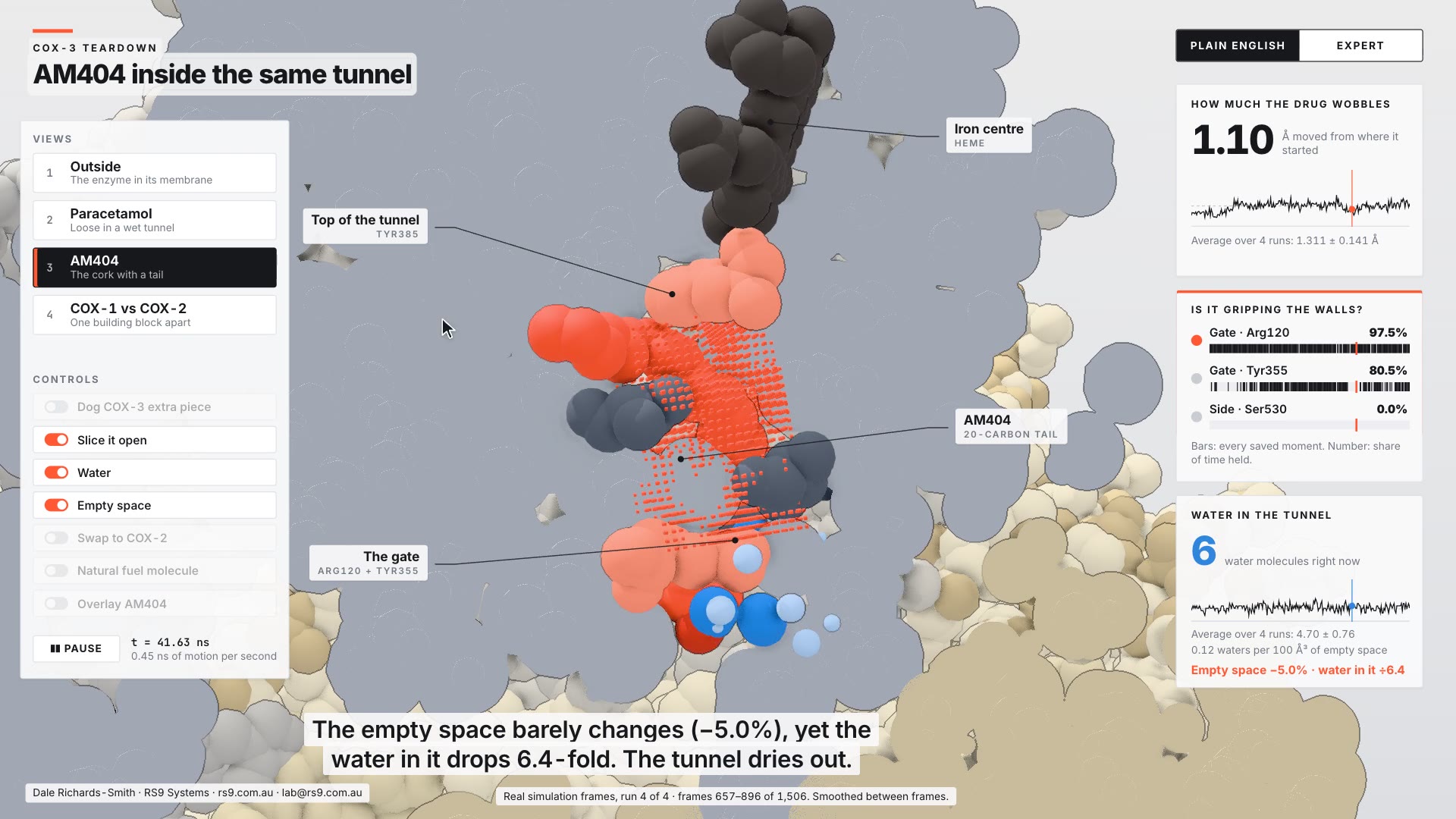
In the atom-by-atom runs, AM404 holds one steady position (1.311 ± 0.141 Å of wobble) while paracetamol drifts about (1.838 ± 0.310 Å). AM404 also clears most of the water out of the tunnel: 4.70 ± 0.76 waters against 9.78 ± 0.67 waters for paracetamol, which leaves the tunnel as wet as an empty one.
Interactive
The interactive model
Spin the enzyme, cut it open and watch each molecule in the tunnel. It walks through the same four scenes the cards below describe. It runs on your own machine, so give it a moment to start.
Interactive model
Film
The launch film
A one-minute recorded tour of the same model, with sound: the enzyme in its membrane, the dog-only extra piece, paracetamol and AM404 in the tunnel, and COX-1 against COX-2.
The four views
What each scene in the model shows.
View 1
The enzyme in its membrane
COX-1 works as a pair, sitting half-buried in the oily sheet of membrane inside the cell, like two buoys floating on the same raft. The dog-only extra piece sits right out on the outside surface, loose and shapeless, nowhere near the part that makes prostaglandins or the part a drug would block.
In the model shown, the dog-only piece comes no closer than 13.9 Å to the iron centre (the heme group) and 19.7 Å to the top of the tunnel, and never touches either.
View 2
Paracetamol rattling in a flooded tunnel
Paracetamol is a small molecule, and the tunnel it has to block is long. It gets in and cannot easily get out, but it never settles: it floats near the top of the tunnel, drifting out of contact for about a sixth of the time, while water keeps flowing past it.
9.78 ± 0.67 waters of water stay in the tunnel with paracetamol in it, almost exactly what an empty tunnel holds (9.73 ± 1.22 waters). It loses contact in 17.4% of frames.
View 3
AM404: a cork with a long tail
The brain turns some paracetamol into AM404, a much bigger molecule: a head much like paracetamol’s, joined to a long fatty tail. The head latches onto the gate at the bottom of the tunnel and holds there, while the tail reaches all the way to the top. Between them they fill the tunnel and push the water out.
The head holds onto the gate residue almost the whole time (0.975 ± 0.012 of the run) and the tunnel empties of water to 0.117 ± 0.047 waters per 100 ų, against 0.754 ± 0.066 waters per 100 ų with paracetamol.
View 4
One letter apart: the COX-1 and COX-2 side pocket
COX-1 and COX-2 differ by a single building block at one spot on the tunnel wall. COX-1 has the bulkier one, which keeps a small side room shut; COX-2 has the smaller one, which opens it. That one swap is what lets some painkillers hit one enzyme and not the other. The natural molecule the enzyme is built for, arachidonic acid, threads the same route AM404 takes.
COX-1 keeps Ile523 where COX-2 has Val523. The natural molecule sits at Arg120 3.31 Å, Ser530 2.54 Å, Tyr385 2.81 Å from the same three landmarks AM404 touches.
Genomic discovery
What the gene reading shows
Step through the four pieces of the genetic argument. The bar is drawn to the real lengths, so you can see how little has to change to break the reading.
In dogs, the extra piece fits
The gene is read three letters at a time. The extra piece dogs keep is 90 nt long, and 90 divides by three, so the reading stays in step. It simply adds 30 amino acids to the front of a normal enzyme, with no stop signs inside it. The dog version also folds its RNA so the splicing machinery cannot easily reach the join, which is why the piece gets kept at all.
Methods and provenance
Methods in brief
Everything here comes from public data and from simulations run in the RS9 lab. Nothing was measured in a person or a dish for this study.
- Reading the gene
- Gene coordinates and splice joins were pulled from the public reference, and the RNA was folded in software to see how reachable each join is.
- Counting single molecules
- Individual long reads covering this stretch of the gene were pulled out of 57 alignment files public human datasets, fetching only the bytes needed (883.9 MB of 88.29 GB).
- Looking for the protein
- A list of 44 protein fragments unique to the hypothetical enzyme was searched against the global human protein database, and seven brain and blood-vessel mass-spectrometry files were re-searched from scratch.
- Building the structures
- Pairs of the enzyme, with their iron cofactor and each molecule in place, were predicted in 3D so the shapes could be compared directly.
- Simulating the membrane
- The enzyme was placed in a realistic membrane and run atom by atom, 4 replicates per arm, about 75.30 ns per replicate each.
- Testing the difference
- Each simulation run counted as one measurement, not each frame, which is the strict way to do it and is why the strongest result reads as roughly a 3-in-100 chance of coming up by luck.
Limits, stated plainly
Computational study
Everything here was worked out from public data and computer simulation. Nothing was measured in a person or in a dish for this paper.
Short simulations
The atom-by-atom runs cover about 75 nanoseconds each. Real drug binding and unbinding takes thousandths of a second or longer, so these runs show how steady a pose is, not how strongly the drug binds.
Detection limits, not proof of zero
No sign of a human COX-3 was found, but "none found" always comes with a limit. In human brain the data could still hide a version at under about one in ten of the readings.
Affinity numbers are a ranking, not a measurement
The predicted binding strengths put AM404 ahead of the enzyme’s natural substrate, and both far ahead of paracetamol. Treat that as an order, not an exact number.
COX-1 only, and no redox chemistry
The simulations cover COX-1, not its cousin COX-2, and they do not model the electron-swapping chemistry that is the best-supported way paracetamol dampens these enzymes in the body.
AM404 levels in people are unknown
Nobody has yet measured how much AM404 forms in a human brain after a normal dose of paracetamol, so how much of this matters in a patient is still open.
Data and code
Ensembl v113, GTEx v10, ENCODE, UCSC GWIPS-viz, GEO GSE213204, PeptideAtlas 2026-01, ProteomicsDB, PRIDE PXD018602 and PXD000004, RCSB PDB 1EQG, 1DIY, 3N8Z, 6Y3C
Every number on this page is taken from the manuscript or from the machine-readable result summaries behind it, with the source recorded next to each value in the page source.
Cite this work
Richards-Smith, D. (2026). Absence of a Functional Human COX-3 Proteoform and Structural Basis for Canonical COX-1 Engagement by the Brain Paracetamol Metabolite AM404. RS9 Systems preprint, November 2026.
Correspondence: [email protected]
Scope
What this does and does not change
Nothing here changes how paracetamol should be used. Its effect on pain and fever is well established and runs through several routes at once, including brain pain channels and a chemical reaction at a second site on these same enzymes that these simulations do not cover. At the doses people take, the amount of paracetamol reaching the fluid around the brain (20–26 µM by mouth, ~39 µM by drip) is far below what would be needed to block the tunnel by sheer bulk, but well within range for that chemical reaction.